The payments industry stands at the forefront of digital transformation, with artificial intelligence (AI) rapidly becoming a cornerstone technology that powers a variety of solutions, from fraud detection to customer service. According to the following Number Analytics report, digital payment transactions are projected to exceed $15 trillion globally by 2027. Generative AI has expanded the scope and urgency of responsible AI in payments, introducing new considerations around content generation, conversational interfaces, and other complex dimensions. As financial institutions and payment solutions providers increasingly adopt AI solutions to enhance efficiency, improve security, and deliver personalized experiences, the responsible implementation of these technologies becomes paramount. According to the following McKinsey report, AI could add an estimated $13 trillion to the global economy by 2030, representing about a 16% increase in cumulative GDP compared with today. This translates to approximately 1.2% additional GDP growth per year through 2030.
AI in payments helps drive technological advancement and strengthens building trust. When customers entrust their financial data and transactions to payment systems, they expect convenience and security, additionally fairness, transparency, and respect for their privacy. AWS recognizes the critical demands facing payment services and solution providers, offering frameworks that can help executives and AI practitioners transform responsible AI into a potential competitive advantage. The following Accenture report has additional statistics and data about responsible AI.
This post explores the unique challenges facing the payments industry in scaling AI adoption, the regulatory considerations that shape implementation decisions, and practical approaches to applying responsible AI principles. In Part 2, we provide practical implementation strategies to operationalize responsible AI within your payment systems.
Payment industry challenges
The payments industry presents a unique landscape for AI implementation, where the stakes are high and the potential impact on individuals is significant. Payment technologies directly impact consumers’ financial transactions and merchant options, making responsible AI practices an important consideration and a critical necessity.
The payments landscape—encompassing consumers, merchants, payment networks, issuers, banks, and payment processors—faces several challenges when implementing AI solutions:
- Data classification and privacy – Payment data is among the most sensitive information. In addition to financial details, it also includes patterns that can reveal personal behaviors, preferences, and life circumstances. Due to various regulations, AI systems that process these data systems are required to maintain the highest standards of privacy protection and data security.
- Real-time processing requirements – Payment systems often require split-second decisions, such as approving a transaction, flagging potential fraud, or routing payments. Production AI systems seek to deliver high standards for accuracy, latency, and cost while maintaining security and minimizing friction. This is important because failed transactions or incorrect decisions might result in poor customer experience or other financial loss.
- Global operational context – Payment providers often operate across jurisdictions with varying regulatory frameworks and standards. These include India’s Unified Payments Interface (UPI), Brazil’s PIX instant payment system, the United States’ FedNow and Real-Time Payments (RTP) networks, and the European Union’s Payment Services Directive (PSD2) and Single Euro Payments Area (SEPA) regulations. AI systems should be adaptable enough to function appropriately across these diverse contexts while adhering to consistent responsible standards.
- Financial inclusion imperatives – The payment industry seeks to expand access to financial services for their customers. It’s important to design AI systems that promote inclusive financial access by mitigating bias and discriminatory outcomes. Responsible AI considerations can help create equitable opportunities while delivering frictionless experiences for diverse communities.
- Regulatory landscape – The payments industry navigates one of the economy’s most stringent regulatory environments, with AI implementation adding new layers of compliance requirements:
- Global regulatory frameworks – From the EU’s General Data Protection Regulation (GDPR) and the upcoming EU AI Act to the Consumer Financial Protection Bureau (CFPB) guidelines in the US, payment solution providers navigate disparate global requirements, presenting a unique challenge for scaling AI usage across the globe.
- Explainability requirements – Regulators increasingly demand that financial institutions be able to explain AI-driven decisions, especially those that impact consumers directly, like multimodal AI for combining biometric, behavioral, and contextual authentication.
- Anti-discrimination mandates – Financial regulations in many jurisdictions explicitly prohibit discriminatory practices. AI systems should be designed and monitored to help prevent inadvertent bias in decisions related to payment approvals and comply with fair lending laws.
- Model risk management – Regulatory frameworks like Regulation E in the US require financial institutions to validate models, including AI systems, and maintain robust governance processes around their development, implementation, and ongoing monitoring.
The regulatory landscape for AI in financial services continues to evolve rapidly. Payment providers strive to stay abreast of changes and maintain flexible systems that can adapt to new requirements.
Core principles of responsible AI
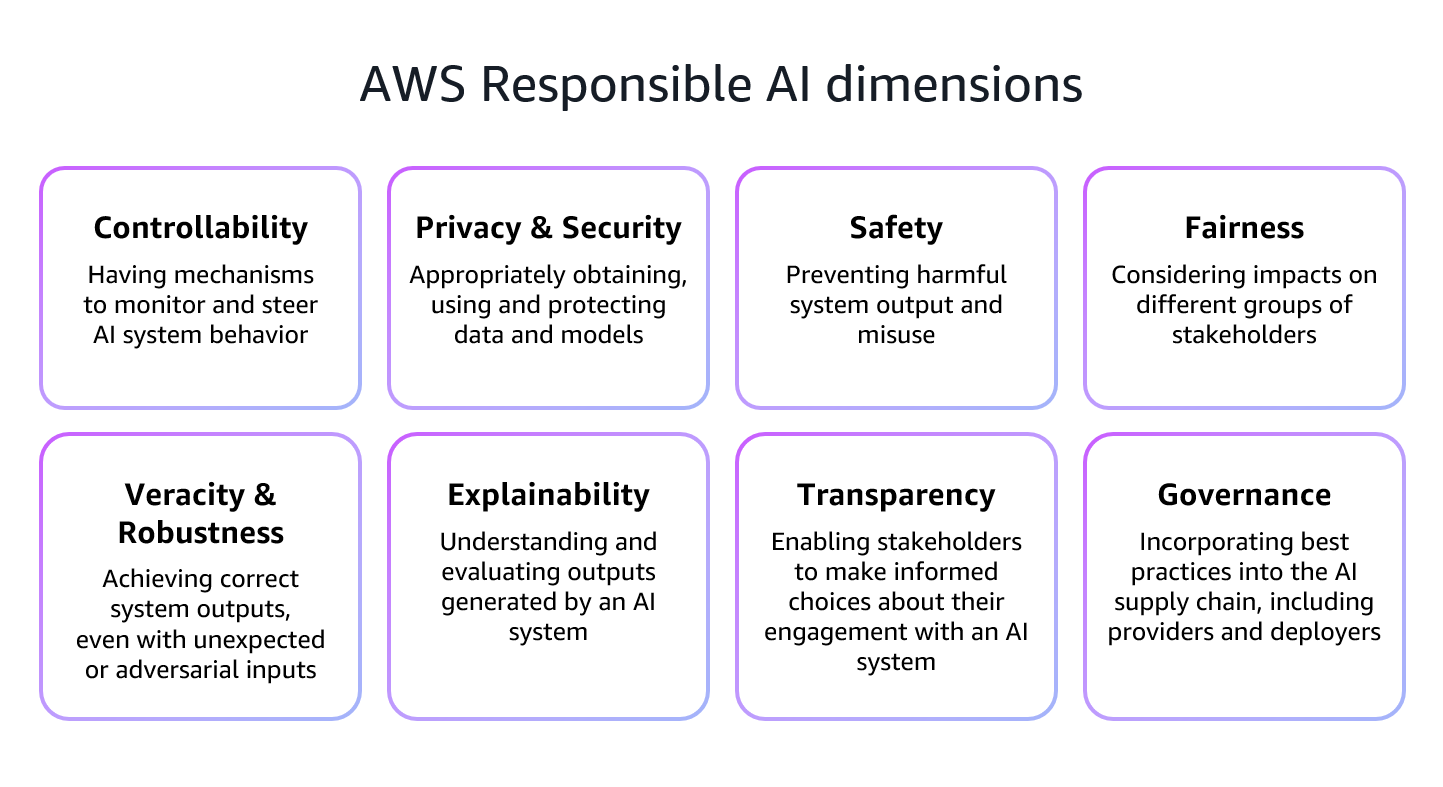
In the following sections, we review how responsible AI considerations can be applied in the payment industry. The core principles include controllability, privacy and security, safety, fairness, veracity and robustness, explainability, transparency, and governance, as illustrated in the following figure.
Controllability
Controllability refers to the extent to which an AI system behaves as designed, without deviating from its functional objectives and constraints. Controllability promotes practices that keep AI systems within designed limits while maintaining human control. This principle requires robust human oversight mechanisms, allowing for intervention, modification, and fine-grained control over AI-driven financial processes. In practice, this means creating sophisticated review workflows, establishing clear human-in-the-loop protocols for high-stakes financial decisions, and maintaining the ability to override or modify AI recommendations when necessary.
In the payment industry, you can apply controllability in the following ways:
- Create human review workflows for high-value or unusual transactions using Amazon Augmented AI (Amazon A2I). For more details, see Automate digitization of transactional documents with human oversight using Amazon Textract and Amazon A2I.
- Develop override mechanisms for AI-generated fraud alerts. One possible approach could be implementing a human-in-the-loop system. For an example implementation, refer to Implement human-in-the-loop confirmation with Amazon Bedrock Agents.
- Establish clear protocols to flag and escalate AI-related decisions that impact customer financial health. This can help establish a defined path to take in the case of any discrepancy or anomalies.
- Implement configurable AI systems that can be adjusted based on specific institutional policies. This can help make sure the AI systems are agile and flexible with ever-evolving changes, which can be configurable to steer model behavior accordingly.
- Design user interfaces (UIs) in which users can provide context or challenge AI-driven decisions.
Privacy and security: Protecting consumer information
Given the sensitive nature of financial data, privacy and security represent a critical consideration in AI-driven payment systems. A multi-layered protection strategy might include advanced encryption protocols, rigorous data minimization techniques, and comprehensive safeguards for personally identifiable information (PII). Compliance with global data protection regulations represents a legal requirement and is also a fundamental commitment to responsibly protecting individuals’ most sensitive financial information.
In the payment industry, you can maintain privacy and security with the following methods:
- Implement advanced encryption for all transaction data. Use AWS Key Management Service (AWS KMS) for encrypting data at rest and Transport Layer Security (TLS) for encrypting data in transit.
- Implement environment segmentation for a multi-layered protection strategy.
- Apply differential privacy techniques. For more details, see How differential privacy helps unlock insights without revealing data at the individual-level.
- Create anonymized datasets for AI training that can’t be traced back to individual customers.
- Develop secure multi-factor authentication systems powered by AI. This can be done using multi-factor authentication for IAM.
Safety: Mitigating potential risks
Safety in AI-driven payment systems focuses on proactively identifying and mitigating potential risks. This involves developing comprehensive risk assessment frameworks (such as NIST AI Risk Management Framework, which provides structured approaches to govern, map, measure, and manage AI risks), implementing advanced guardrails to help prevent unintended system behaviors, and creating fail-safe mechanisms that protect both payment solutions providers and users from potential AI-related vulnerabilities. The goal is to create AI systems that work well and are fundamentally reliable and trustworthy.
In the payment industry, you can implement safety measures as follows:
- Develop guardrails to help prevent unauthorized transaction patterns. One possible way is using Amazon Bedrock Guardrails. For an example solution, see Implement model-independent safety measures with Amazon Bedrock Guardrails.
- Create AI systems that can detect and help prevent potential financial fraud in real-time.
- Implement multi-layered risk assessment models for complex financial products. One possible method is using an Amazon SageMaker inference pipeline.
- Design fail-safe mechanisms that can halt AI decision-making during anomalous conditions. This can be done by architecting the system to determine anomalous behavior, flagging it, and possibly adding a human in the loop for those transactions.
- Implement red teaming and perform penetration testing to identify potential system vulnerabilities before they can be exploited.
Fairness: Detect and mitigate bias
To create a more inclusive financial landscape and promote demographic parity, fairness should be a key consideration in payments. Financial institutions are required to rigorously examine their AI systems to mitigate potential bias or discriminatory outcomes across demographic groups. This means algorithms and training data for applications such as credit scoring, loan approval, or fraud detection should be carefully calibrated and meticulously assessed for biases.
In the payment industry, you can implement fairness in the following ways:
- Assess models and data for the presence and utilization of attributes such as gender, race, or socioeconomic background to promote demographic parity. Tools such as Amazon Bedrock Evaluations or Amazon SageMaker Clarify can help evaluate and assess the application’s bias in data and model output.
- Implement observability, monitoring, and alerts using AWS services like Amazon CloudWatch to support regulatory compliance and provide non-discriminatory opportunities across customer demographics.
- Evaluate data used for model training for biases using tools like SageMaker Clarify to correct and mitigate disparities.
These guidelines can be applied for various payment applications and processes, including fraud detection, loan approval, financial risk assessment, credit scoring, and more.
Veracity and robustness: Promoting accuracy and reliability
Truthful and accurate system output is an important consideration for AI in payment systems. By continuously validating AI models, organizations can make sure that financial predictions, risk assessments, and transaction analyses maintain consistent accuracy over time. To achieve robustness, AI systems must maintain performance across diverse scenarios, handle unexpected inputs, and adapt to changing financial landscapes without compromising accuracy or reliability.
In the payment industry, you can apply robustness through the following methods:
- Create AI models that maintain accuracy across diverse economic conditions.
- Implement rigorous testing protocols that simulate various financial scenarios. For example test tools, refer to Test automation.
- Create cross-validation mechanisms to verify AI model predictions. SageMaker provides built-in cross-validation capabilities, experiment tracking, and continuous model monitoring, and AWS Step Functions orchestrates complex validation workflows across multiple methods. For critical predictions, Amazon A2I enables human-in-the-loop validation.
- Use Retrieval Augmented Generation (RAG) and Amazon Bedrock Knowledge Bases to improve accuracy of AI-powered payment decision systems, reducing the risk of hallucinations.
Explainability: Making complex decisions understandable
Explainability bridges the gap between complex AI algorithms and human understanding. In payments, this means developing AI systems can articulate the reasoning behind its decisions in clear, understandable terms. AI should provide insights that are meaningful and accessible to users and financial professionals explaining a risk calculation, fraud detection flag, or transaction recommendation depending on the business use case.
In the payment industry, you can implement explainability as follows:
- Generate consumer-friendly reports that break down complex financial algorithms.
- Create interactive tools so users can explore the factors behind their financial assessments.
- Develop visualization tools that demonstrate how AI arrives at specific financial recommendations.
- Provide regulatory compliance-aligned documentation that explains AI model methodologies.
- Design multilevel explanation systems that cater to both technical and non-technical audiences.
Transparency: Articulate the decision-making process
Transparency refers to providing clear, accessible, and meaningful information that helps stakeholders understand the system’s capabilities, limitations, and potential impacts. Transparency transforms AI from an opaque black box into a human understandable, communicative system. In the payments sector, this principle demands that AI-powered financial decisions be both accurate and explicable. Financial institutions should be able to evidence how credit limits are determined, why a transaction might be flagged, or how a financial risk assessment is calculated.
In the payment industry, you can promote transparency in the following ways:
- Create interactive dashboards that break down how AI calculates transaction risks. You can use services like Amazon QuickSight to build interactive dashboards and data stories. You can use SageMaker for feature importance summary or SHAP (SHapley Additive exPlanations) reports that quantify how much each input feature contributes to a model’s prediction for a specific instance.
- Offer real-time notifications that explain why a transaction was flagged or declined. You can send notifications using Amazon Simple Notification Service (Amazon SNS).
- Develop customer-facing tools that help users understand the factors influencing their credit scores. AI agents can provide interactive feedback about the factors involved and deliver more details to users. You can build these AI agents using Amazon Bedrock.
Governance: Promoting accuracy and reliability
Governance establishes the framework for responsible AI implementation and ongoing monitoring and management. In payments, this means creating clear structures for AI oversight, defining roles and responsibilities, and establishing processes for regular review and intervention when necessary. Effective governance makes sure AI systems operate within established responsible AI boundaries while maintaining alignment with organizational values and regulatory requirements.
In the payment industry, you can apply governance as follows:
- Implement cross-functional AI review boards with representation from legal, compliance, and ethics teams.
- Establish clear escalation paths for AI-related decisions that require human judgment.
- Develop comprehensive documentation of AI system capabilities, limitations, and risk profiles.
- Create regular audit schedules to evaluate AI performance against responsible AI dimensions.
- Design feedback mechanisms that incorporate stakeholder input into AI governance processes.
- Maintain version control and change management protocols for AI model updates.
Conclusion
As we’ve explored throughout this guide, responsible AI in the payments industry represents both a strategic imperative and competitive advantage. By embracing the core principles of controllability, privacy, safety, fairness, veracity, explainability, transparency, and governance, payment providers can build AI systems that enhance efficiency and security, and additionally foster trust with customers and regulators. In an industry where financial data sensitivity and real-time decision-making intersect with global regulatory frameworks, those who prioritize responsible AI practices will be better positioned to navigate challenges while delivering innovative solutions. We invite you to assess your organization’s current AI implementation against these principles and refer to Part 2 of this series, where we provide practical implementation strategies to operationalize responsible AI within your payment systems.
As the payments landscape continues to evolve, organizations that establish responsible AI as a core competency will mitigate risks and build stronger customer relationships based on trust and transparency. In an industry where trust is the ultimate currency, responsible AI is a responsible choice and an important business imperative.
To learn more about responsible AI, refer to the AWS Responsible Use of AI Guide.
About the authors
 Neelam Koshiya Neelam Koshiya is principal Applied AI Architect (GenAI specialist) at AWS. With a background in software engineering, she moved organically into an architecture role. Her current focus is to help enterprise customers with their ML/ genAI journeys for strategic business outcomes. She likes to build content/mechanisms to scale to larger audience. She is passionate about innovation and inclusion. In her spare time, she enjoys reading and being outdoors.
 Ana Gosseen Ana is a Solutions Architect at AWS who partners with independent software vendors in the public sector space. She leverages her background in data management and information sciences to guide organizations through technology modernization journeys, with particular focus on generative AI implementation. She is passionate about driving innovation in the public sector while championing responsible AI adoption. She spends her free time exploring the outdoors with her family and dog, and pursuing her passion for reading.