This post is co-written with Rudra Kannemadugu and Shravan K S from Indegene Limited.
In today’s digital-first world, healthcare conversations are increasingly happening online. Yet the life sciences industry has struggled to keep pace with this shift, facing challenges in effectively analyzing and deriving insights from complex medical discussions on a scale. This post will explore how Indegene is using services like Amazon Bedrock, Amazon SageMaker, and purpose-built AWS solutions for healthcare and life sciences to help pharmaceutical companies extract valuable, actionable intelligence from digital healthcare conversations.
Indegene Limited is a digital-first, life sciences commercialization company. It helps pharmaceutical, emerging biotech, and medical device companies develop products, get them to customers, and grow their impact through the healthcare lifecycle in a more effective, efficient, and modern way. Trusted by global leaders in the pharma and biotech space, Indegene brings together healthcare domain expertise, fit-for-purpose technology, and an agile operating model to provide a diverse range of solutions. They aim to deliver a personalized, scalable and omnichannel experience for patients and physicians.
Life sciences companies face unprecedented challenges in effectively understanding and engaging with healthcare professionals (HCPs) and patients. Indegene’s Digital-Savvy HCP Report reveals that 52% of HCPs now prefer receiving medical and promotional content from pharmaceutical companies through social media (such as LinkedIn, Twitter, YouTube, or Facebook). This number is up significantly from 41% in 2020. Despite this shift, pharma companies are struggling to deliver high-quality experiences. A study by DT Consulting (an Indegene company) shows the industry currently holds a Customer Experience Quality (CXQ) score of 58. Although this rating is considered good, it merely meets basic expectations and falls short of the excellence benchmark, defined by a CXQ score of 76–100.
This post explores how Indegene’s Social Intelligence Solution uses advanced AI to help life sciences companies extract valuable insights from digital healthcare conversations. Built on AWS technology, the solution addresses the growing preference of HCPs for digital channels while overcoming the challenges of analyzing complex medical discussions on a scale.
Digital transformation challenges in life sciences
Consider the scenario in the following figure: A patient shares their healthcare journey on social media, including details about their medical condition, treatment protocol, healthcare provider, medication usage patterns, treatment efficacy, and experienced side effects. When such patient narratives are collected at scale and processed through analytical models, they provide valuable strategic insights for pharmaceutical companies.
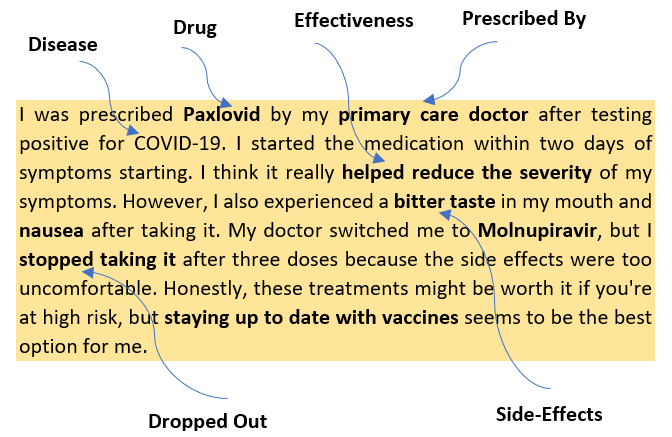
This has created an urgent need for sophisticated, healthcare-focused solutions that can automatically capture, analyze, and transform these digital conversations into actionable business intelligence.Social intelligence in healthcare can help companies achieve the following:
- Monitor brand sentiment and reputation – Track relevant conversations in real time (forward listening) and historically (backward listening) to monitor sentiment and trends around specific drugs or brands.
- Gauge launch reactions and adjust strategies – Monitor product launches to assess public reaction, identify leading indicators, and detect trends for brand switching, adverse events, or off-label drug use.
- Identify and monitor key decision-makers – Enhance outreach by identifying and engaging with key influencers, particularly HCPs, by analyzing their posts and interactions across social media channels.
- Gain competitive intelligence – Track brand sentiment and patient behavior patterns to identify emerging trends, gauge competitor performance, and adapt business strategies proactively.
Key challenges in healthcare social listening
Life sciences organizations recognize that customer-centricity becomes more attainable when decision-making is informed by data. Consequently, they are increasingly embracing strategies that use data to enhance customer experience and drive business outcomes. However, they face significant challenges:
- Obsolete engagement methods – Traditional in-person interactions are becoming less effective as medical conversations migrate to digital channels.
- Complex healthcare terminology – Standard social listening tools can’t adequately process healthcare-specific language, regulatory considerations, and authentic HCP identification.
- Real-time insight requirements – Critical information about treatment preferences and product feedback emerges rapidly, outpacing manual analysis methods.
Solution overview
With over 25 years of industrial experience, Indegene has built and continues to evolve their specialized Social Intelligence Solution on AWS, adapting to emerging healthcare and life sciences (HCLS) needs and use cases. This solution aims to transform how life sciences companies understand and engage with their stakeholders by combining machine learning (ML), natural language processing (MLP), and generative AI capabilities. Key differentiators of the solution include:
- Broad social media integration – Provides automated data collection with comprehensive coverage across social media channels.
- Healthcare-focused analytics – Delivers deep insights into pharmaceutical-specific attributes, including stakeholder segmentation, safety, and efficacy.
- Targeted HCP identification – Uniquely detects and categorizes social media profiles of healthcare professionals for precision targeting.
- Comprehensive insight capabilities – Provides granular analysis of conversations with sentiment analysis for nuanced understanding.
The following diagram illustrates an end-to-end life sciences system that integrates multiple functional layers. Starting from the bottom, it flows from data acquisition through data management layers, up to AI/ML core processing and customer-facing applications (such as HCP and DOL identification, and conference listening). The right side showcases supporting techno-functional services, including security, DevOps, and enterprise interfaces.
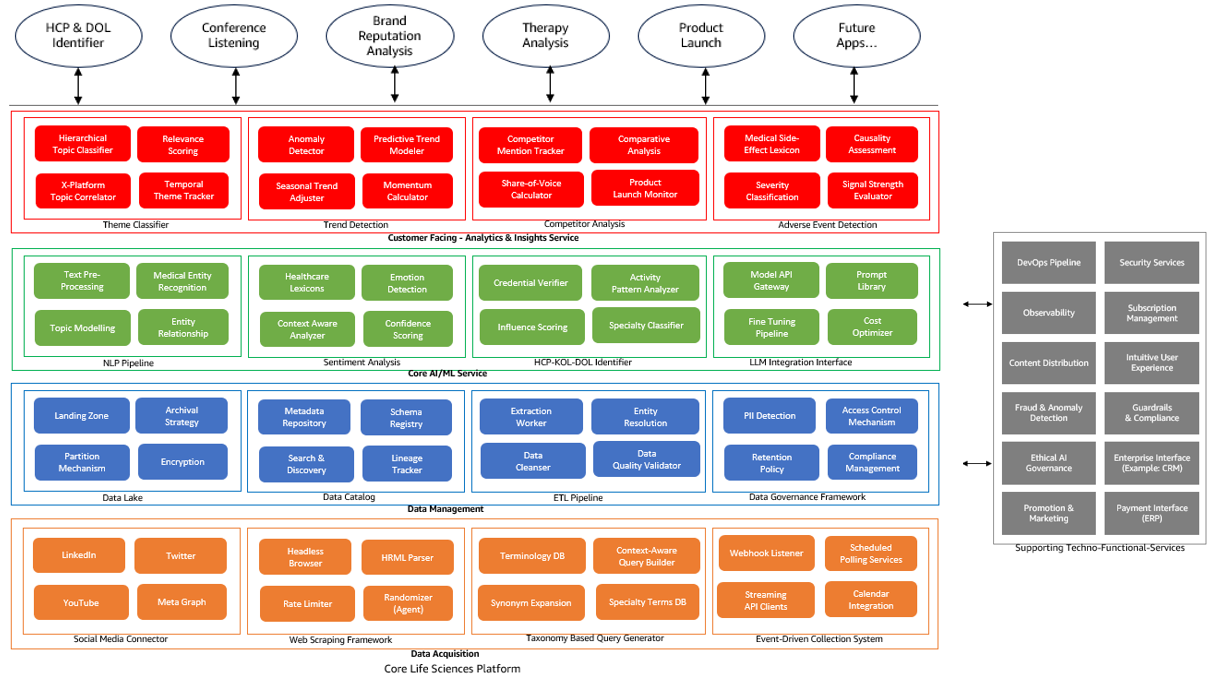
The system employs a modular, extensible architecture that transforms unstructured social data into actionable healthcare insights while maintaining regulatory compliance. This layered design allows for continuous evolution, helping pharmaceutical companies implement diverse use cases beyond initial applications.
Architecture layers
The architecture consists of the following layers:
- Data acquisition layer – This foundation layer features specialized components for social media connectivity across channels like LinkedIn, Twitter, and YouTube, alongside sophisticated web scraping frameworks with rate limiting and randomization capabilities. A standout feature is the taxonomy-based query generator that uses healthcare terminology databases to create contextually relevant searches across medical conversations.
- Data management layer – This layer provides robust data lake functionality with comprehensive governance features, including personally identifiable information (PII) detection, retention policies, and lineage tracking to help maintain regulatory compliance. This layer’s metadata repository and schema registry make sure complex healthcare data remains organized and discoverable, and extraction workers and data cleansers maintain data quality essential for reliable analytics. For more information, see Building and Scaling Robust and Effective Enterprise Data Governance in Life Sciences.
- Core AI/ML service layer – This layer represents the system’s intelligence center, offering healthcare-specific capabilities like medical entity recognition, credential verification for healthcare professionals, and specialized sentiment analysis tuned for medical contexts. The system’s context-aware analyzer and confidence scoring mechanisms make sure insights reflect the nuanced nature of healthcare discussions, and the HCP-KOL-DOL identifier provides critical stakeholder classification capabilities unavailable in generic social listening tools. For more information, see Five must-have AI capabilities to lead the commercial race in life sciences.
- Customer-facing analytics layer – This layer delivers actionable insights through specialized modules, including anomaly detection, predictive trend modeling, and adverse event detection, with medical side effect lexicons. Particularly valuable are the comparative analysis tools and share-of-voice calculators that provide competitive intelligence specific to the pharmaceutical industry. These components work together to power purpose-built applications like HCP identification, conference listening, brand reputation analysis, and patient sentiment tracking—all designed to help pharmaceutical companies navigate the increasingly digital healthcare conversation landscape with precision and compliance alignment.
A layered system-based modular approach offers the following benefits for healthcare use cases:
- Reusability – The dynamic nature of healthcare-digital engagement demands flexible customer-facing solutions (top-layer). A modular approach provides reusable components that adapt to changing business use cases without requiring core infrastructure rebuilds. This approach delivers controlled implementation costs, consistent scalability and reliability, and minimal time-to-market.
- Extensibility and separation of concerns – The solution separates four fundamental building blocks: data acquisition mechanisms, compliance-aligned data lifecycle management, healthcare-optimized AI/ML services, and domain-specific analytics. Given the accelerating pace of innovation in each area (from new social channels to advanced language models), these components must evolve independently with meticulously defined interfaces between them. This separation helps specialized teams update individual components without disrupting overall system performance or compliance requirements.
- Standardization – Enterprise-wide consistency forms the backbone of a reliable healthcare analytics solution. Authentication, authorization, integration with enterprise systems like ERP and CRM, observability mechanisms, and security controls must follow standardized patterns across the entire social listening channels. When dealing with HCP identification and medical conversations, these standardized guardrails become not just technical best practices but essential regulatory and compliance requirements.
- Domain adaptation – What fundamentally distinguishes our approach from generic social media channels is our deep domain-specific implementation tailored for life sciences. Whereas lower layers like data acquisition and management follow industry standards, our upper layers deliver specialized capabilities engineered specifically for healthcare contexts. Identifying healthcare professionals in social conversations with high precision, enabling taxonomy-based querying across complex medical hierarchies, and contextualizing medical terminology within appropriate clinical frameworks are capabilities with transformative utility in life sciences applications. This domain specialization creates unique value that generic solutions simply cannot match, providing Indegene with a distinctive competitive advantage in helping pharmaceutical companies bridge the digital engagement gap revealed in our research.
Implementation on AWS
Indegene’s Social Intelligence Solution’s layered architecture can be efficiently implemented using AWS’s comprehensive suite of services, providing scalability, security, and specialized capabilities for life sciences analytics.
Data acquisition layer
The data acquisition layer orchestrates diverse data collection mechanisms to gather insights from multiple social and professional channels while facilitating compliance-aligned and efficient ingestion:
- Amazon Managed Streaming for Apache Kafka (Amazon MSK) and Amazon Kinesis – Provide the backbone for real-time data ingestion from social media channels, handling high-throughput event streams from Twitter, LinkedIn, and other sources with built-in fault tolerance and robust message retention.
- AWS Lambda – Powers the event-driven collection system, triggering data capture based on scheduled polling or webhook events.
- Amazon AppFlow – Simplifies integration with social media APIs through no-code connectors to social media channels like LinkedIn and Twitter.
- AWS Glue crawlers – Systematically extract data from web sources using headless browser capabilities, with rate limiting and randomization to facilitate ethical data collection.
- Amazon Neptune – Stores and traverses complex medical terminology relationships needed for taxonomy-based query generation.
Data management layer
The data management layer demands robust storage, cataloging, and governance solutions:
- Amazon Simple Storage Service (Amazon S3) – Serves as the cost-optimized data lake foundation, with intelligent tiering to automatically move less-accessed historical social data to lower-cost storage classes.
- AWS Lake Formation – Provides fine-grained access controls and governance for the data lake, which is critical for managing sensitive healthcare information.
- AWS Glue Data Catalog – Maintains the metadata repository and schema registry, making social media data discoverable and queryable.
- Amazon EMR – Powers the extract, transform, and load (ETL) pipeline for large-scale data transformation, particularly useful for processing historical social media archives.
- Amazon Comprehend Medical – Assists with PII detection in the data governance framework, identifying and helping protect sensitive healthcare information that might appear in social conversations.
Core AI/ML service layer
This critical layer uses AWS’s advanced AI capabilities to transform raw social data into healthcare-specific insights:
- Amazon Bedrock and Amazon SageMaker AI – Form the centerpiece of the ML implementation with foundation models (FMs) fine-tuned for healthcare terminology.
- Amazon ElastiCache for Redis – Implements high-performance Retrieval Augmented Generation (RAG) caching, dramatically improving response times for common healthcare queries and reducing computational costs.
Amazon Bedrock serves as the cornerstone of the solution’s AI capabilities, offering several advantages for life sciences applications. It is a fully managed service that offers a choice of industry-leading large language models (LLMs) to build generative AI applications.
Amazon Bedrock minimizes the substantial infrastructure management burden typically associated with deploying LLMs, helping life sciences companies focus on insights rather than complex ML operations. Amazon Bedrock FMs can be specialized for healthcare terminology through domain adaptation, enabling accurate interpretation of complex medical discussions.
The RAG capabilities of Amazon Bedrock Knowledge Bases are particularly valuable for incorporating medical ontologies and taxonomies, making sure AI responses reflect current medical understanding and regulatory contexts.
Amazon Bedrock Custom Model Import helps pharmaceutical companies use their proprietary domain-specific models and intellectual property, which is critical for companies with established investments in specialized healthcare AI.
For pharmaceutical companies monitoring product launches or adverse events, Amazon Bedrock Prompt Management allows for consistent, validated queries across different monitoring scenarios. Operational efficiency is significantly enhanced through Amazon Bedrock prompt caching mechanisms, which reduce redundant processing of similar queries and substantially lower costs—particularly valuable when analyzing recurring patterns in healthcare conversations. Amazon Bedrock Intelligent Prompt Routing enables intelligent distribution of tasks across multiple state-of-the-art LLMs, helping teams seamlessly compare and select the optimal model for each specific use case, such as Anthropic’s Claude for nuanced sentiment analysis, Meta Llama for rapid classification, or proprietary models for specialized pharmaceutical applications.
The Amazon Bedrock comprehensive responsible AI framework is particularly crucial in healthcare applications. The built-in evaluation tools enable systematic assessment of model outputs for fairness, bias, and accuracy in medical contexts, which is essential when analyzing diverse patient populations. Amazon Bedrock transparency features provide detailed model cards and lineage tracking, helping pharmaceutical companies document and justify AI-driven decisions to regulatory authorities. The human-in-the-loop workflows facilitate expert review of critical healthcare insights before they influence business decisions, and comprehensive audit logging creates the documentation trail necessary for compliance in regulated industries.
Amazon Bedrock Guardrails is especially valuable in the life sciences context, where guardrails can be configured with domain-specific constraints to help prevent the extraction or exposure of protected health information. These guardrails can be tailored to automatically block requests for individual patient information, personal details of healthcare professionals, or other sensitive data categories specific to pharmaceutical compliance requirements. This capability makes sure that even as the solution analyzes millions of healthcare conversations, it can maintain strict adherence to HIPAA, GDPR, and industry-specific privacy standards. The ability to implement these comprehensive guardrails makes sure the AI outputs comply with pharmaceutical marketing regulations and patient privacy requirements.
Amazon Bedrock Agents can automate routine monitoring tasks while escalating potential adverse events or off-label discussions for human review.
By implementing fine-tuning pipelines through Amazon Bedrock, the solution continuously improves its understanding of emerging medical terminology and evolving social media language patterns, making sure the insights remain relevant as digital healthcare conversations evolve.
Customer-facing analytics and insights service layer
The solution’s analytics capabilities transform processed data into actionable business intelligence:
- Reporting – Delivers interactive dashboards and visualizations of brand sentiment, competitor analysis, and trend detection with healthcare-specific visualizations and metrics.
- Amazon Managed Service for Apache Flink – Enables real-time trend detection and anomaly identification in streaming social media data, which is particularly valuable for monitoring adverse event signals.
- AWS Step Functions – Orchestrates complex analytics workflows like adverse event detection that require multiple processing steps and human review.
- Amazon Athena – Provides SQL queries against the processed social media data lake, helping business users explore patterns without complex data engineering.
- Amazon Lex – Powers natural language interfaces, helping users query and interact with social media insights through conversational AI.
Supporting techno-functional services
The solution’s enterprise integration and operational capabilities use AWS’s comprehensive management tools:
- AWS Control Tower and AWS Organizations – Implement guardrails and compliance controls essential for life sciences applications.
- Amazon CloudWatch and AWS X-Ray – Provide comprehensive observability across the solution, with specialized monitoring for healthcare-specific metrics and compliance indicators.
- AWS AppSync – Builds the intuitive user experience layer with real-time data synchronization.
- AWS AppFlow and Amazon API Gateway – Enable enterprise interface integration with CRM and ERP systems.
- Amazon Cognito – Delivers secure user authentication and authorization, with role-based access controls appropriate for different stakeholder groups within pharmaceutical organizations.
This AWS-powered implementation delivers the benefits we have discussed—reusability, extensibility, standardization, and domain adaptation—while providing the security, compliance-alignment, and performance capabilities essential for life sciences applications.
Example use case
Let’s explore the implementation of a domain-specific, taxonomy-based query generation system for social media data analysis. A typical implementation comprises the following components:
- Medical terminology database – This repository stores standardized medical terminology from SNOMED CT, MeSH, and RxNorm. It returns detailed information about queried terms, including synonyms, parent categories, and codes. For example, querying “diabetes” returns alternatives like “diabetes mellitus” and “DM” with classification data. The database maintains specialty-specific collections for fields such as oncology and cardiology, enabling precise medical language processing.
- Synonym expansion engine – This engine expands medical terms into sets of clinically equivalent expressions. For a term like “insulin pump,” it retrieves medical synonyms such as “CSII” from the terminology database, supplements these with general language alternatives, and handles abbreviations. The resulting synonym list makes sure queries capture content regardless of terminology variations.
- Context-aware query builder – This component transforms medical term lists into optimized search queries. It uses the Synonym Expansion Engine for each term, formats synonym groups with Boolean operators, and applies system-specific syntax. When targeting healthcare professional content, it adds credential filters. The output balances comprehensiveness with system constraints to maximize relevant result retrieval.
- Query effectiveness analyzer – This analyzer evaluates query performance and provides improvement recommendations. It calculates metrics including result relevance, topic diversity, and healthcare professional content ratio. Using NLP to identify medical entities, it suggests specific improvements such as broadening queries with few results or adding professional filters when needed.
- Taxonomy-based query generator – This orchestrator manages the entire workflow as the main client interface. It coordinates with other components to construct optimized queries and packages results with expansion metadata. It also evaluates search results to provide performance metrics and improvement suggestions, delivering sophisticated search capabilities through a simplified interface.
The following sequence diagram illustrates a typical use case for a taxonomy-driven query lookup.
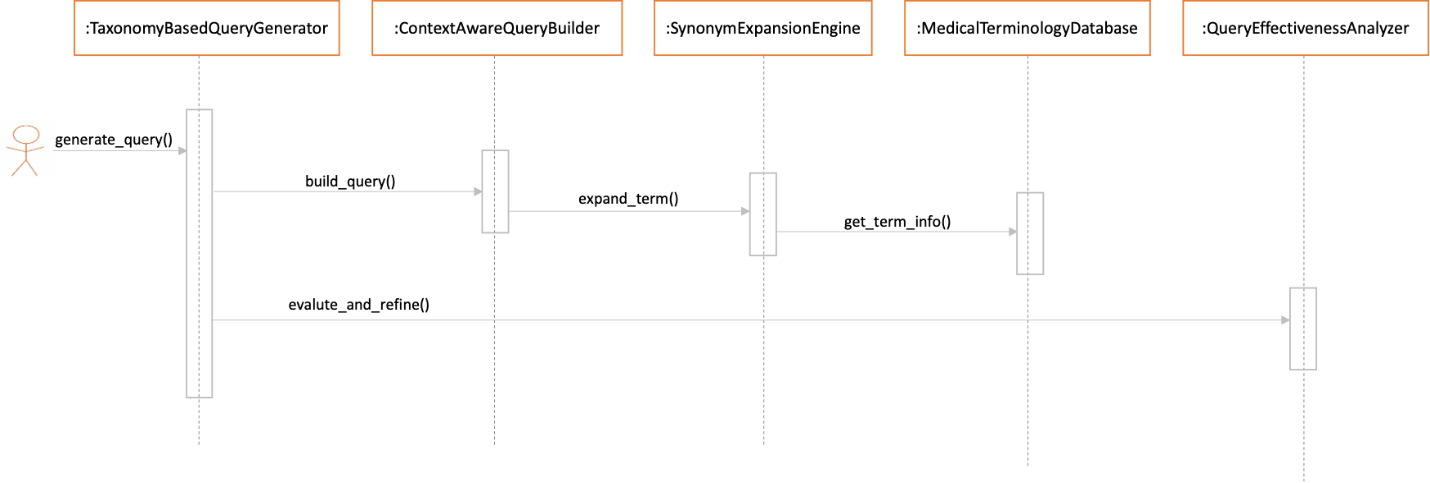
A typical user journey narrative includes the following phases:
- Step 1: User intent – The user enters two simple terms, “diabetes” and “insulin pump,” into the search interface. They specify they want to search on Twitter and only see content from healthcare professionals. This basic information is passed on to our query enhancement system, which begins the process of creating a more comprehensive search.
- Step 2: Expand first term – The system looks up “diabetes” in its medical terminology database (SNOMED CT). It identifies several related terms and technical variations, including “diabetes mellitus” (the formal medical term), “DM” (common medical abbreviation), “T1DM” (Type 1 diabetes mellitus), and “T2DM” (Type 2 diabetes mellitus). The system incorporates these terms to make sure the search captures the full spectrum of diabetes-related discussions.
- Step 3: Expand second term – The system then consults its database (MeSH terminology) for “insulin pump” and discovers related clinical terms such as “insulin infusion pump” (formal medical device name), “continuous subcutaneous insulin infusion” (clinical procedure name), and “CSII” (common medical abbreviation). These variations are integrated into the search query to capture the different terminology healthcare professionals might use when discussing this treatment approach.
- Step 4: Build enhanced query – The system intelligently combines the expanded terms into organized groups: Group 1 (diabetes OR diabetes mellitus OR DM OR T1DM OR T2DM) and Group 2 (insulin pump OR insulin infusion pump OR continuous subcutaneous insulin infusion OR CSII). It connects these groups with AND operators to make sure results contain references to both diabetes and insulin pump technologies, creating a focused yet comprehensive query structure.
- Step 5: Add professional filters – Because the user specifically wants content from healthcare professionals, the system adds specialized filters, including professional title indicators (doctor OR physician OR MD OR clinician OR nurse OR NP OR pharmacist OR PharmD OR healthcare professional OR HCP OR medical) and Twitter’s verification filter (filter: verified). These filters work together to prioritize content from qualified medical experts while filtering out public discussions.
- Step 6: Execution and analysis – The system executes this enhanced query on Twitter and analyzes the returned results to evaluate their relevance and professional source quality. It provides the user with performance metrics such as: “Found 5 results with 80% from verified healthcare professionals.” The query effectiveness analyzer module then offers intelligent suggestions for further refinement, such as incorporating age-specific terms (pediatric, adult, elderly) to better target specific patient populations.
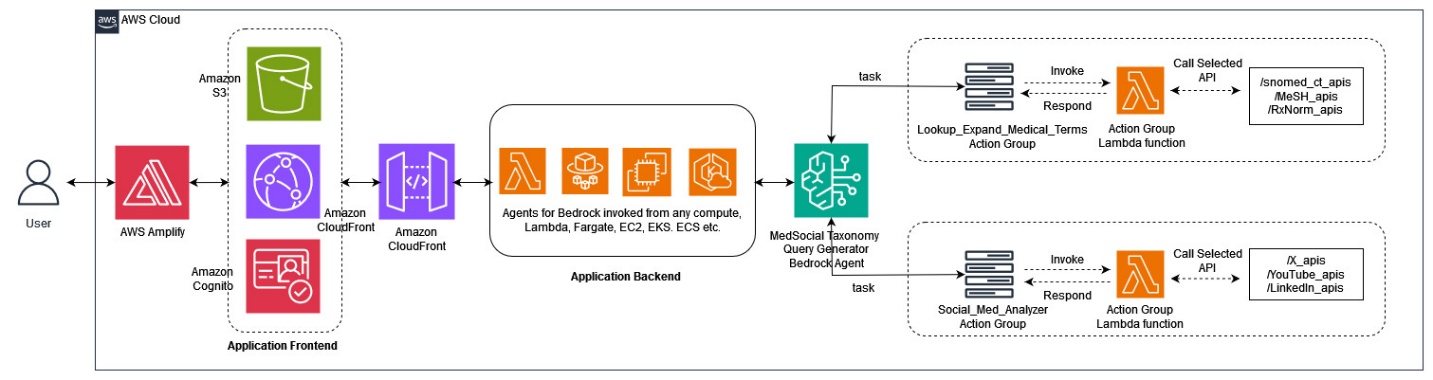
The following diagram illustrates how the taxonomy-based query generation flow can be implemented on AWS using Amazon Bedrock Agents.
Results and next steps
Indegene’s Social Intelligence Solution demonstrates measurable impact across various dimensions:
- Time-to-insight – Reduction in insight generation time
- Operational cost savings – Reduced analytics outsourcing and FTE costs
- Business outcomes – Measured by the percentage of insights used in downstream decision-making
Looking ahead, the solution is evolving to deliver even more comprehensive capabilities:
- Omnichannel intelligence integration – Unify insights across multiple channels, including social media, CRM systems, representative interactions, email campaigns, and HCP prescription behavior, creating a true 360-degree view of stakeholder sentiment and behavior.
- Conference listening capabilities – Use advanced audio/video analysis to extract valuable insights from podcasts, webinars, and live medical conference sessions—formats that have previously been difficult to analyze at scale.
- Conversational insight assistant powered by generative AI – Help users interact with the system through natural language queries and receive real-time, narrative-style summaries of social insights.
Conclusion
This post explored how advancements in generative AI have sparked a change in how pharmaceutical teams access and use social intelligence, transforming insights into instantly accessible and actionable resources across the organization. In future posts, we will explore specific use cases, such as conference listening, Key Opinion Leader (KOL) identification, and Digital Opinion Leader (DOL) identification.To learn more, refer to the following resources:
- Guidance for Social Media Insights on AWS
- Generative AI in Healthcare & Life Sciences
- AWS Skill Builder course: Building Generative AI Applications Using Amazon Bedrock
- GitHub repo: Sample Healthcare and Life Sciences Agents on AWS
About the authors
 Rudra Kannemadugu is a Senior Director–Data and Advanced Analytics at Indegene with 22+ years of experience, leading digital transformation across pharma, healthcare, and retail. He specializes in drug launches, sales force operations, and building enterprise data ecosystems. A strategic leader in GenAI adoption, he drives commercial analytics, predictive modeling, and marketing automation. Rudra is a proven people leader in spearheading AI transformation initiatives and talent development, and is also skilled in cross-functional collaboration and global stakeholder management to accelerate drug commercialization.
 Shravan K S is a Senior Manager–Data Analytics at Indegene and an experienced GenAI Architect with 17+ years in analytics, data platforms, and system integration across life sciences and healthcare. He has led the delivery of secure, scalable solutions in Generative AI, data engineering, platform modernization, and emerging Agentic AI systems. Skilled in driving transformation through SAFe Agile, he advances innovation via cloud-native architectures and AI-driven data operations. He holds advanced certifications from AWS, Snowflake, and Dataiku, and combines cutting-edge technologies with real-world impact in pharma and healthcare analytics.
 Bhagyashree Chandak is a Solutions Architect in the APAC region. She works with customers to design and build innovative solutions in the AWS Cloud, bridging the gap between complex business requirements and technical solutions across various domains. As an AI/ML enthusiast, Bhagyashree has expertise in both traditional ML and advanced GenAI techniques.
 Punyabrota Dasgupta is a Principal Solutions Architect at AWS. His area of expertise includes machine learning applications for media and entertainment business. Beyond work, he loves tinkering and restoration of antique electronic appliances.