Generative AI is transforming how businesses deliver personalized experiences across industries, including travel and hospitality. Travel agents are enhancing their services by offering personalized holiday packages, carefully curated for customer’s unique preferences, including accessibility needs, dietary restrictions, and activity interests. Meeting these expectations requires a solution that combines comprehensive travel knowledge with real-time pricing and availability information.
In this post, we show how to build a generative AI solution using Amazon Bedrock that creates bespoke holiday packages by combining customer profiles and preferences with real-time pricing data. We demonstrate how to use Amazon Bedrock Knowledge Bases for travel information, Amazon Bedrock Agents for real-time flight details, and Amazon OpenSearch Serverless for efficient package search and retrieval.
Solution overview
Travel agencies face increasing demands for personalized recommendations while struggling with real-time data accuracy and scalability. Consider a travel agency that needs to offer accessible holiday packages: they need to match specific accessibility requirements with real-time flight and accommodation availability but are constrained by manual processing times and outdated information in traditional systems. This AI-powered solution combines personalization with real-time data integration, enabling the agency to automatically match accessibility requirements with current travel options, delivering accurate recommendations in minutes rather than hours.The solution uses a three-layer architecture to help travel agents create personalized holiday recommendations:
- Frontend layer – Provides an interface where travel agents input customer requirements and preferences
- Orchestration layer – Processes request and enriches them with customer data
- Recommendation layer – Combines two key components:
- Travel data storage – Maintains a searchable repository of travel packages
- Real-time information retrieval – Fetches current flight details through API integration
The following diagram illustrates this architecture.
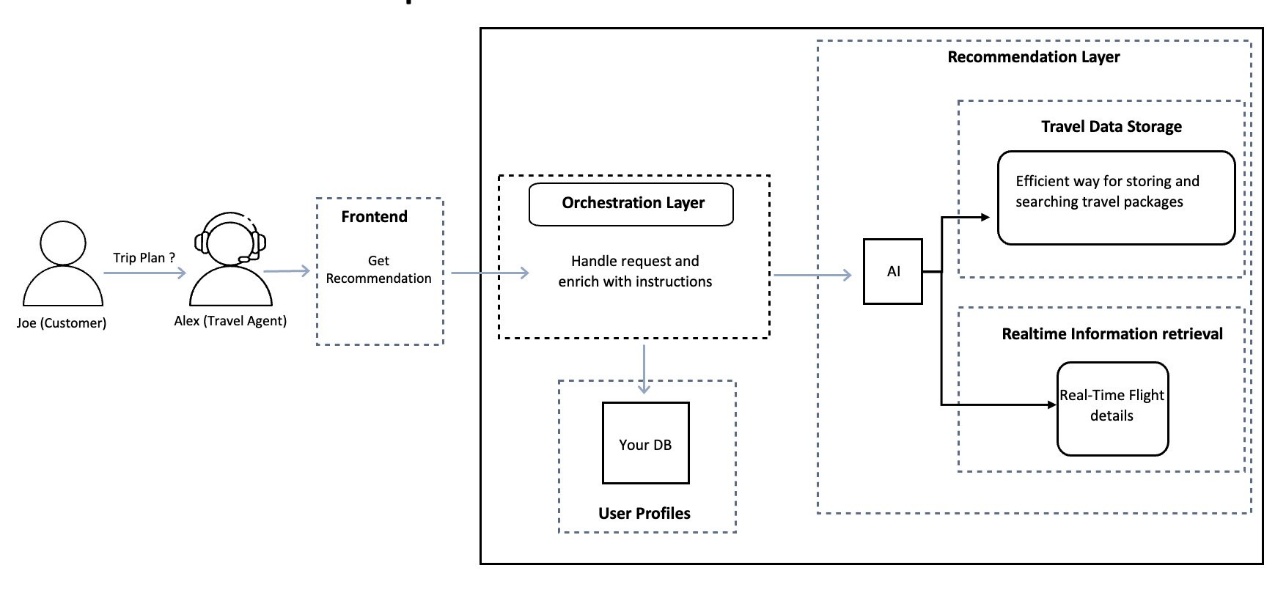
With this layered approach, travel agents can capture customer requirements, enrich them with stored preferences, integrate real-time data, and deliver personalized recommendations that match customer needs. The following diagram illustrates how these components are implemented using AWS services.
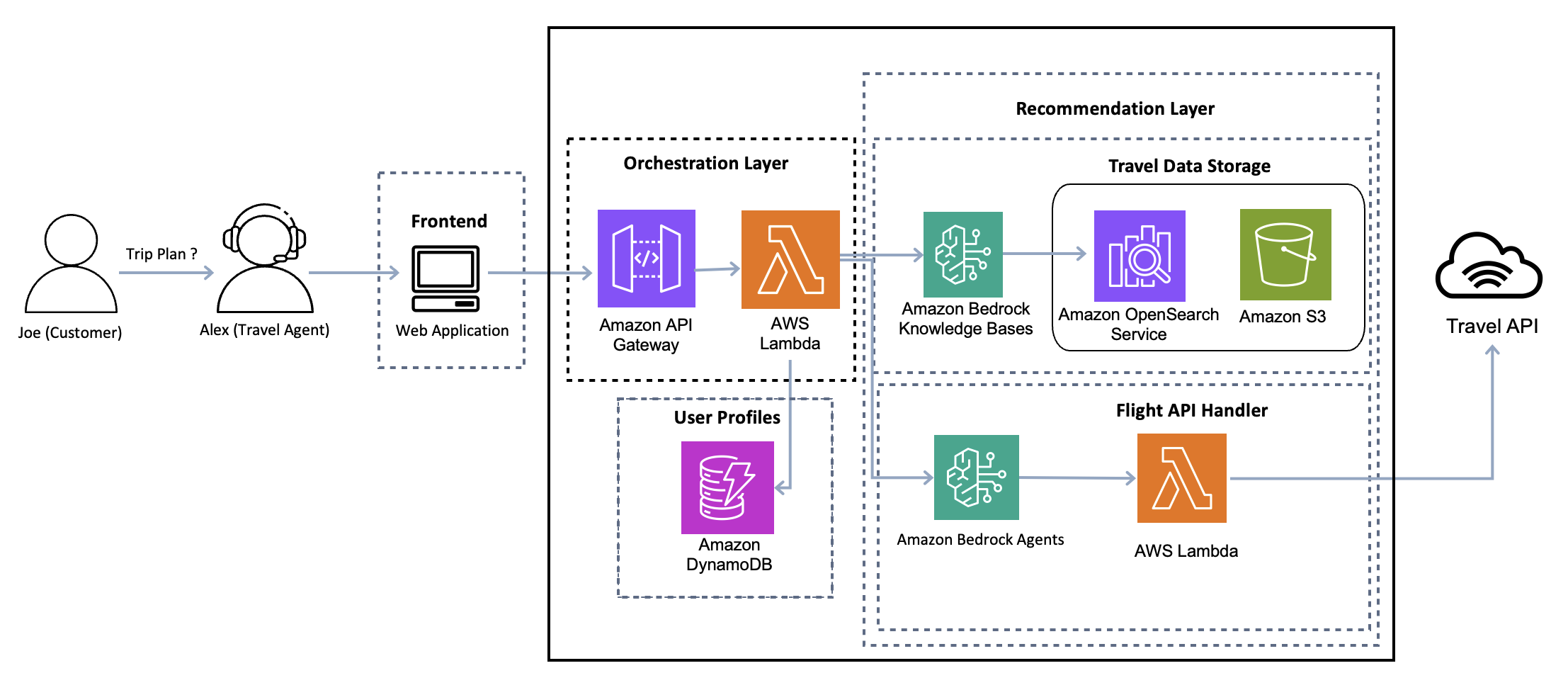
The AWS implementation includes:
- Amazon API Gateway – Receives requests and routes them to AWS Lambda functions facilitating secure API calls for retrieving recommendations
- AWS Lambda – Processes input data, creates the enriched prompt, and executes the recommendation workflow
- Amazon DynamoDB – Stores customer preferences and travel history
- Amazon Bedrock Knowledge Bases – Helps travel agents build a curated database of destinations, travel packages, and deals, making sure recommendations are based on reliable and up-to-date information
- Amazon OpenSearch Serverless – Enables simple, scalable, and high-performing vector search
- Amazon Simple Storage Service (Amazon S3) – Stores large datasets such as flight schedules and promotional materials
- Amazon Bedrock Agents – Integrates real-time information retrieval, making sure recommended itineraries reflect current availability, pricing, and scheduling through external API integrations
This solution uses a AWS CloudFormation template that automatically provisions and configures the required resources. The template handles the complete setup process, including service configurations and necessary permissions.
For the latest information about service quotas that might affect your deployment, refer to AWS service quotas.
Prerequisites
To deploy and use this solution, you must have the following:
- An AWS account with access to Amazon Bedrock
- Permissions to create and manage the following services:
- Amazon Bedrock
- Amazon OpenSearch Serverless
- Lambda
- DynamoDB
- Amazon S3
- API Gateway
- Access to foundation models in Amazon Bedrock for Amazon Titan Text Embeddings V2 and Anthropic Claude 3 Haiku models
Deploy the CloudFormation stack
You can deploy this solution in your AWS account using AWS CloudFormation. Complete the following steps:
- Choose Launch Stack:

You will be redirected to the Create stack wizard on the AWS CloudFormation console with the stack name and the template URL already filled in.
- Leave the default settings and complete the stack creation.
- Choose View stack events to go to the AWS CloudFormation console to see the deployment details.
The stack takes around 10 minutes to create the resources. Wait until the stack status is CREATE_COMPLETE before continuing to the next steps.
The CloudFormation template automatically creates and configures components for data storage and management, Amazon Bedrock, and the API and interface.
Data storage and management
The template sets up the following data storage and management resources:
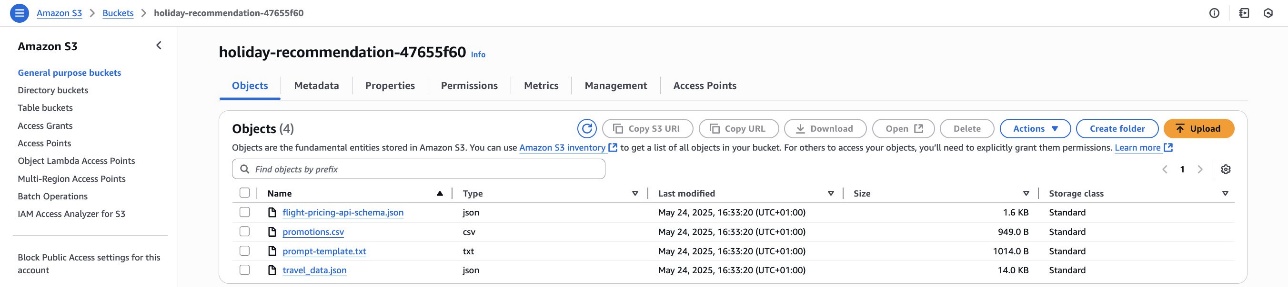
- An S3 bucket and with a sample dataset (
travel_data.jsonandpromotions.csv), prompt template, and the API schema
- DynamoDB tables populated with sample user profiles and travel history

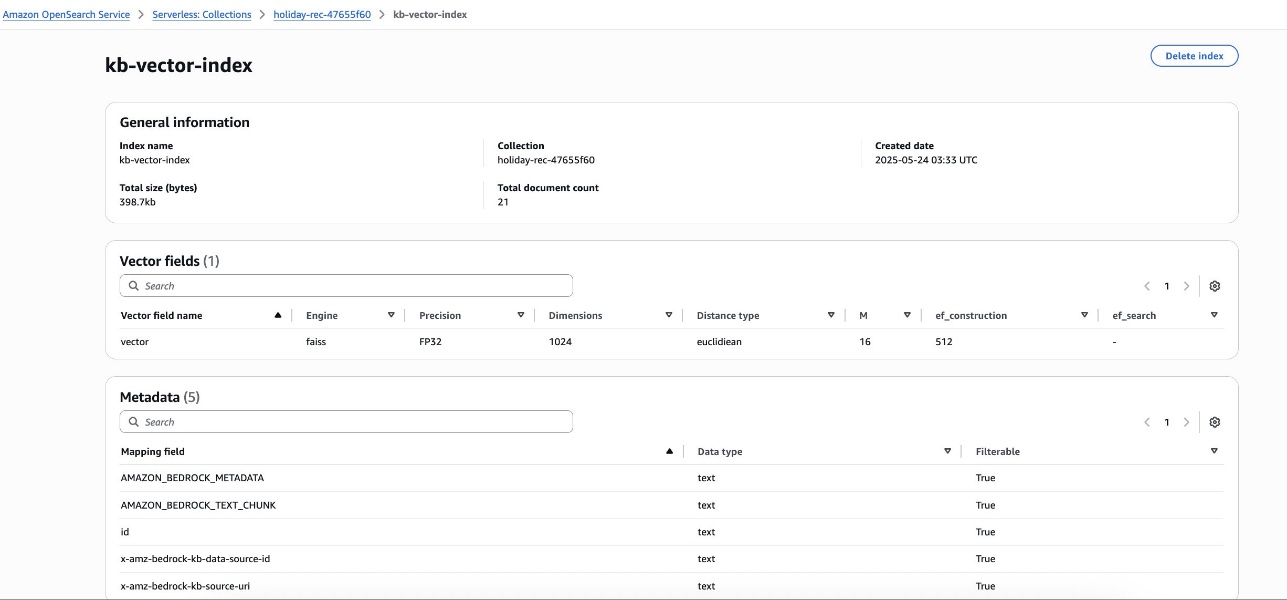
- An OpenSearch Serverless collection with optimized settings for travel package searches
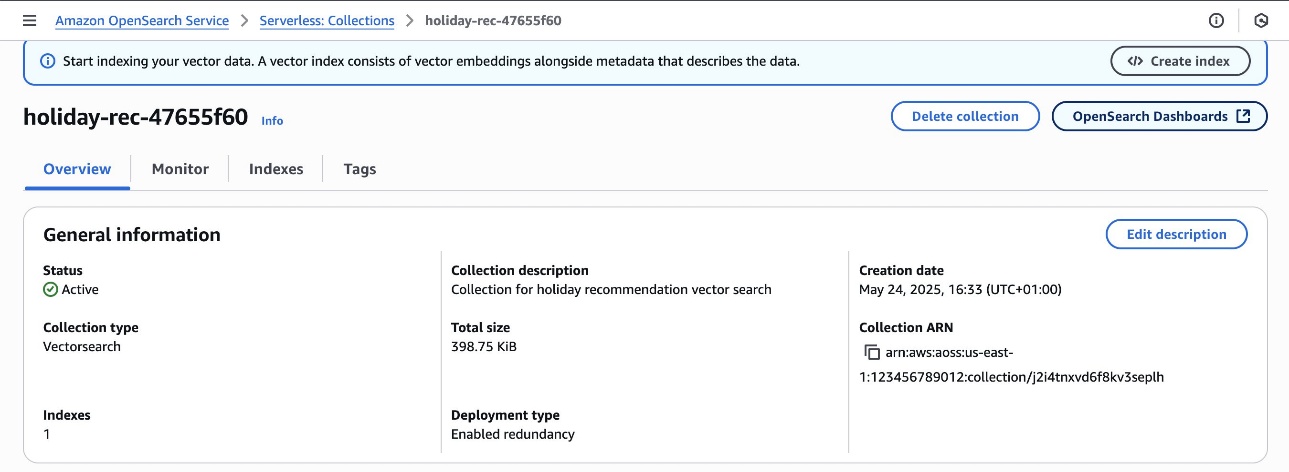
- A vector index with settings compatible with the Amazon Bedrock knowledge base
Amazon Bedrock configuration
For Amazon Bedrock, the CloudFormation template creates the following resources:
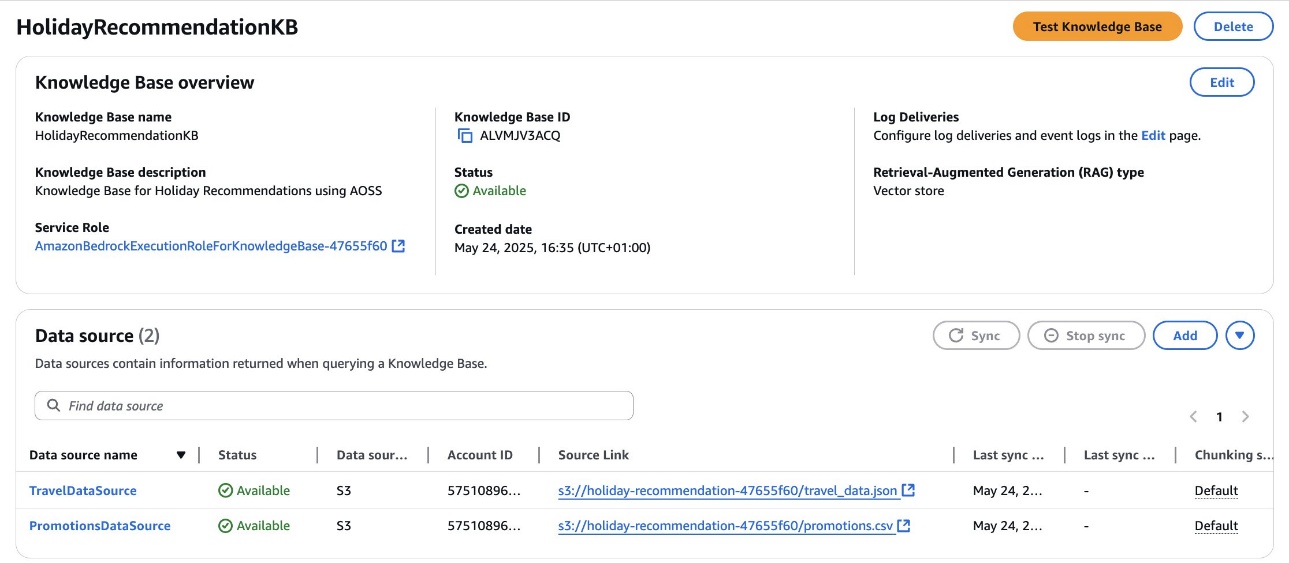
- A knowledge base with the travel dataset and data sources ingested from Amazon S3 with automatic synchronization
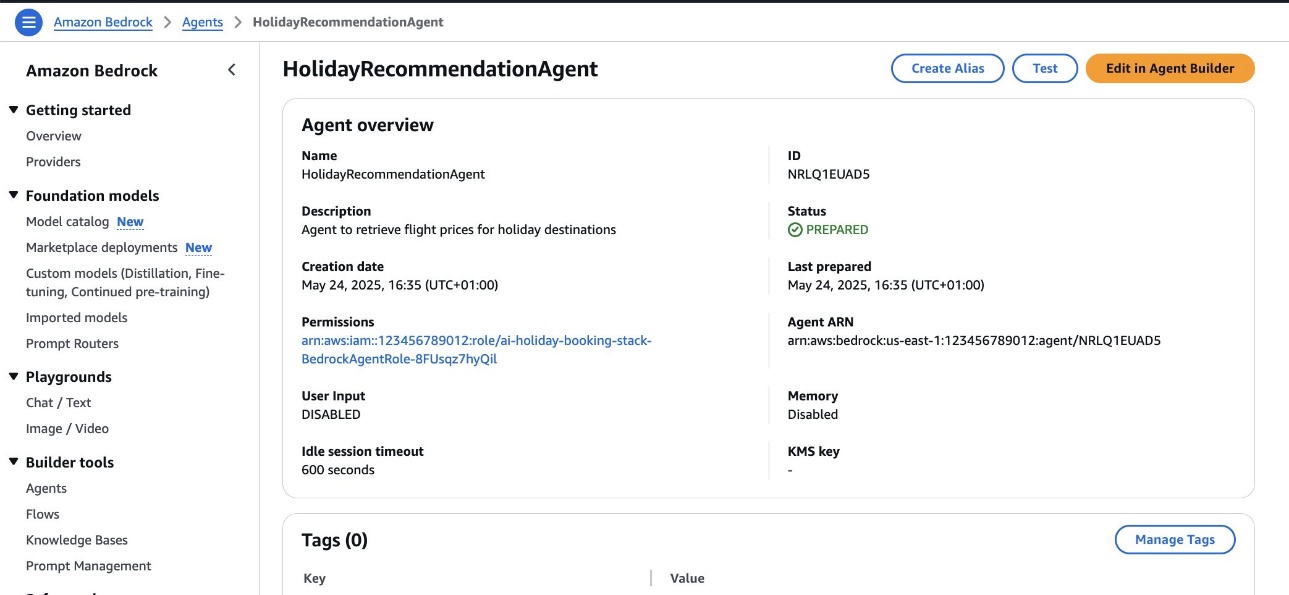
- An Amazon Bedrock agent, which is automatically prepared
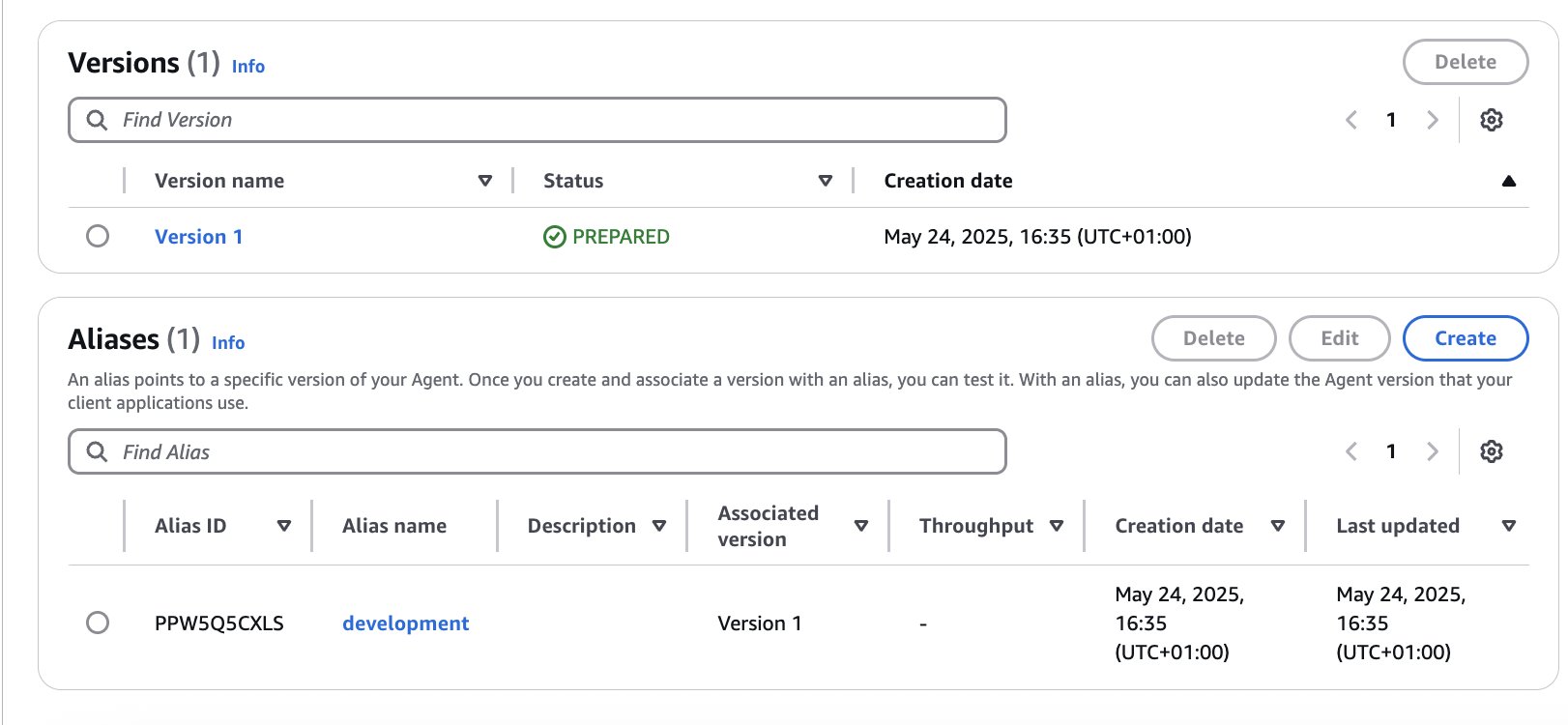
- A new version and alias for the agent
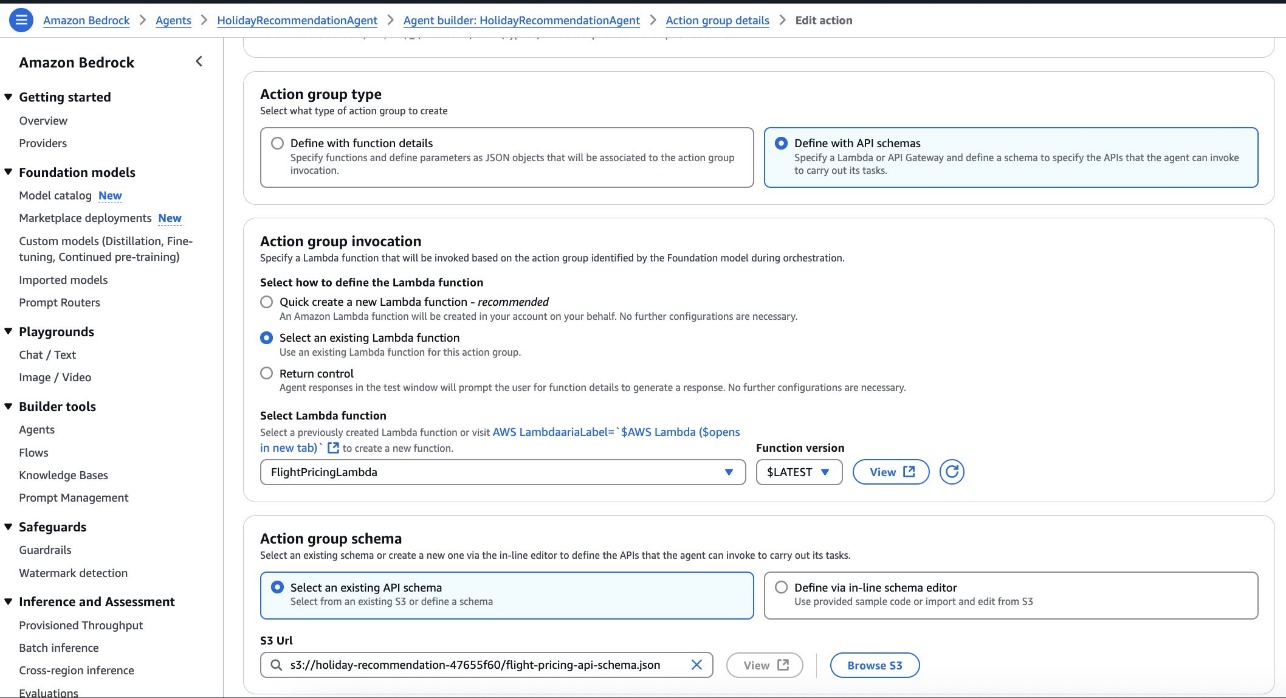
- Agent action groups with mock flight data integration

- An action group invocation, configured with the
FlightPricingLambdaLambda function and the API schema retrieved from the S3 bucket
API and interface setup
To enable API access and the UI, the template configures the following resources:
- API Gateway endpoints
- Lambda functions with a mock flight API for demonstration purposes
- A web interface for travel agents
Verify the setup
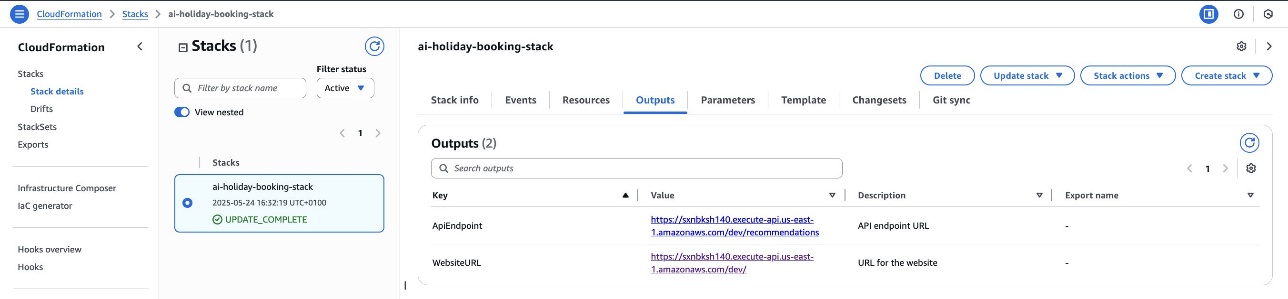
After stack creation is complete, you can verify the setup on the Outputs tab of the AWS CloudFormation console, which provides the following information:
- WebsiteURL – Access the travel agent interface
- ApiEndpoint – Use for programmatic access to the recommendation system
Test the endpoints
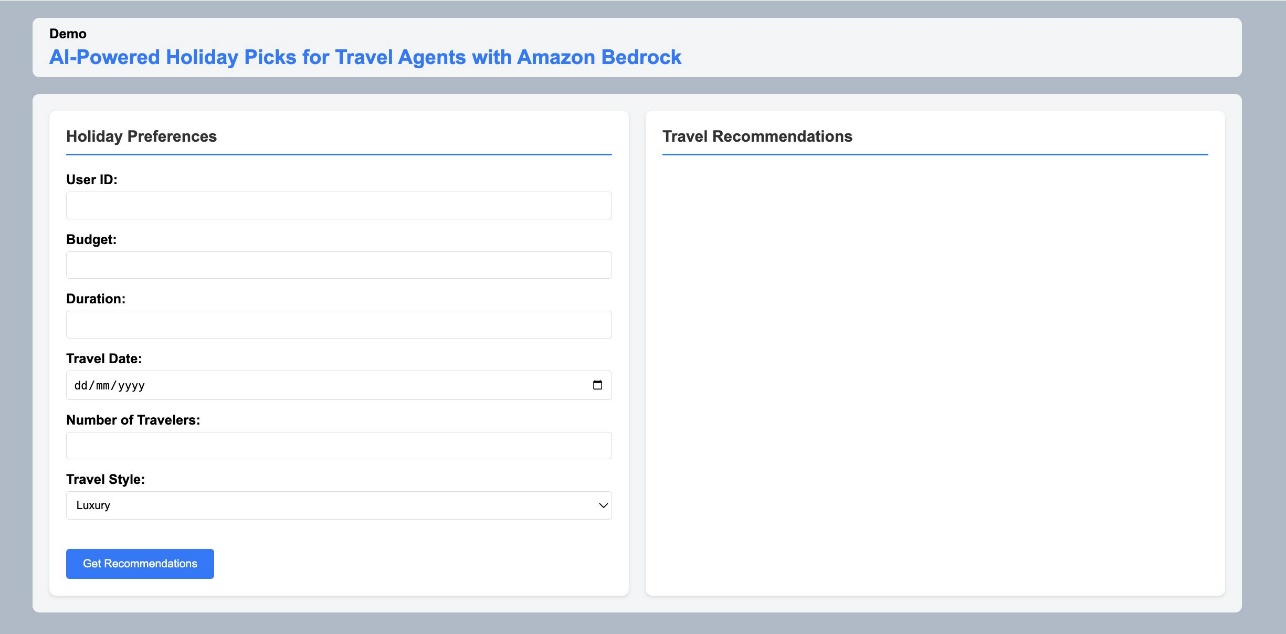
The web interface provides an intuitive form where travel agents can input customer requirements, including:
- Customer ID (for example,
JoeorWill) - Travel budget
- Preferred dates
- Number of travelers
- Travel style
You can call the API directly using the following code:
Test the solution
For demonstration purposes, we create sample user profiles in the UserPreferences and TravelHistory tables in DynamoDB.
The UserPreferences table stores user-specific travel preferences. For instance, Joe represents a luxury traveler with wheelchair accessibility requirements.
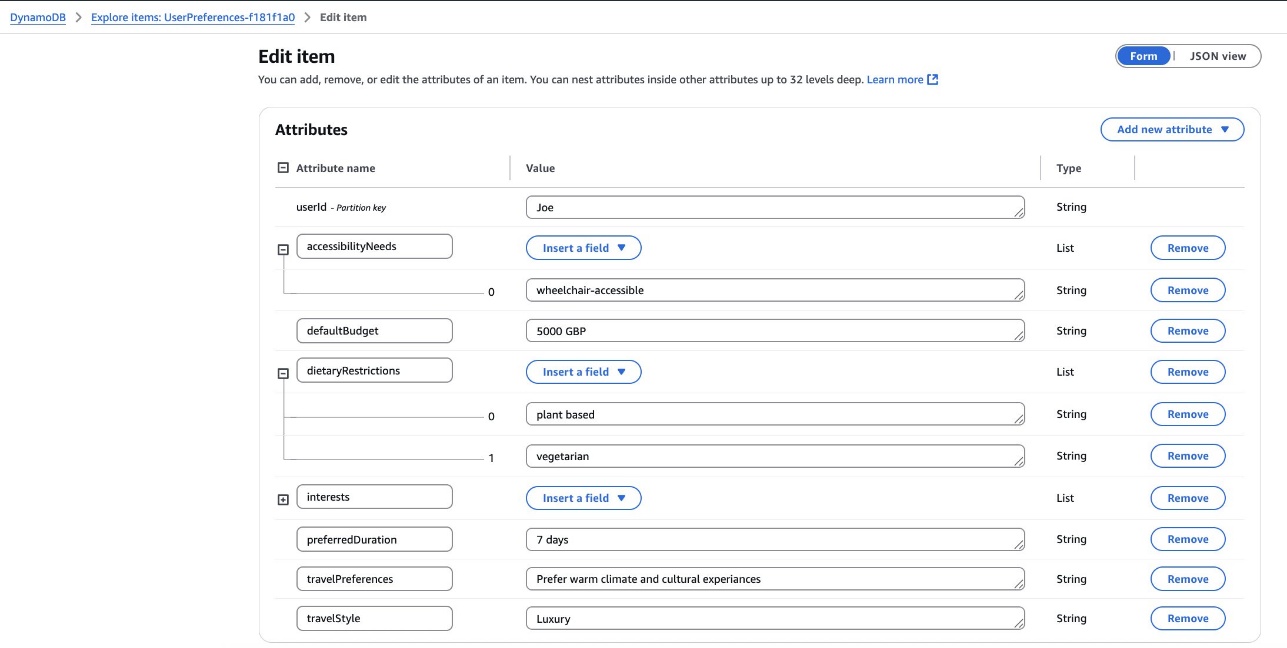
Will represents a budget traveler with elderly-friendly needs. These profiles help showcase how the system handles different customer requirements and preferences.

The TravelHistory table stores past trips taken by users. The following tables show the past trips taken by the user Joe, showing destinations, trip durations, ratings, and travel dates.

Let’s walk through a typical use case to demonstrate how a travel agent can use this solution to create personalized holiday recommendations.Consider a scenario where a travel agent is helping Joe, a customer who requires wheelchair accessibility, plan a luxury vacation. The travel agent enters the following information:
- Customer ID:
Joe - Budget: 4,000 GBP
- Duration: 5 days
- Travel dates: July 15, 2025
- Number of travelers: 2
- Travel style: Luxury
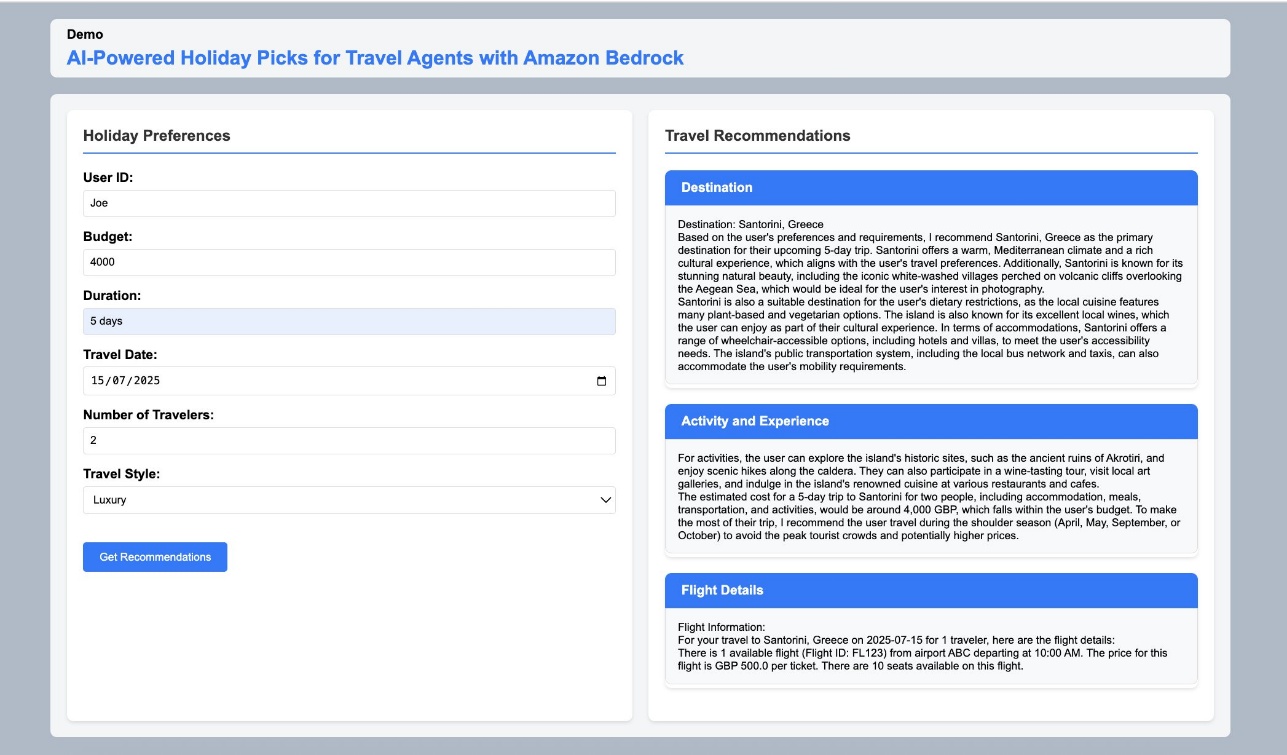
When a travel agent submits a request, the system orchestrates a series of actions through the PersonalisedHolidayFunction Lambda function, which will query the knowledge base, check real-time flight information using the mock API, and return personalized recommendations that match the customer’s specific needs and preferences. The recommendation layer uses the following prompt template:
The system retrieves Joe’s preferences from the user profile, including:
The system then generates personalized recommendations that consider the following:
- Destinations with proven wheelchair accessibility
- Available luxury accommodations
- Flight details for the recommended destination
Each recommendation includes the following details:
- Detailed accessibility information
- Real-time flight pricing and availability
- Accommodation details with accessibility features
- Available activities and experiences
- Total package cost breakdown
Clean up
To avoid incurring future charges, delete the CloudFormation stack. For more information, see Delete a stack from the CloudFormation console.
The template includes proper deletion policies, making sure the resources you created, including S3 buckets, DynamoDB tables, and OpenSearch collections, are properly removed.
Next steps
To further enhance this solution, consider the following:
- Explore multi-agent capabilities:
- Create specialized agents for different travel aspects (hotels, activities, local transport)
- Enable agent-to-agent communication for complex itinerary planning
- Implement an orchestrator agent to coordinate responses and resolve conflicts
- Implement multi-language support using multi-language foundation models in Amazon Bedrock
- Integrate with customer relationship management (CRM) systems
Conclusion
In this post, you learned how to build an AI-powered holiday recommendation system using Amazon Bedrock that helps travel agents deliver personalized experiences. Our implementation demonstrated how combining Amazon Bedrock Knowledge Bases with Amazon Bedrock Agents effectively bridges historical travel information with real-time data needs, while using serverless architecture and vector search for efficient matching of customer preferences with travel packages.The solution shows how travel recommendation systems can balance comprehensive travel knowledge, real-time data accuracy, and personalization at scale. This approach is particularly valuable for travel organizations needing to integrate real-time pricing data, handle specific accessibility requirements, or scale their personalized recommendations. This solution provides a practical starting point with clear paths for enhancement based on specific business needs, from modernizing your travel planning systems or handling complex customer requirements.
Related resources
To learn more, refer to the following resources:
- Documentation:
- Code samples:
- Additional learning:
About the Author
 Vishnu Vardhini
Vishnu Vardhini is a Solutions Architect at AWS based in Scotland, focusing on SMB customers across industries. With expertise in Security, Cloud Engineering and DevOps, she architects scalable and secure AWS solutions. She is passionate about helping customers leverage Machine Learning and Generative AI to drive business value.